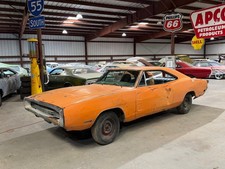
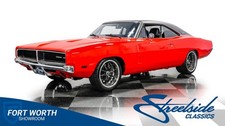
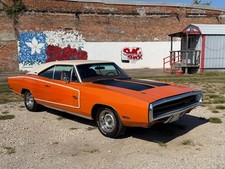
![]() (Image of a 1969 Dodge Charger) |
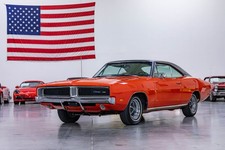
The Dodge Charger is probably one of the most popular and famous muscle cars, thanks in no small part to the hit tv series Dukes of Hazard which featured a 1969 Dodge Charger. The Dodge Charger also had very successful runs in NASCAR during the late 1960's and early 19070's, which added to it's popularity. The Dodge Daytona was a stellar performer on the racetrack.
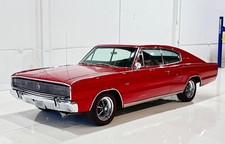
The 1966 Charger was released the same year as the new street version of the 426 Hemi was available, and this made an ultimate combo. Only V8 engines were available. With rotating headlights that blended into the grille making it look like one piece whether the headlights were up or down, to the electroluminescent dash panel, the Charger made waves. Later in the model year a rear spoiler was available, making the 1966 Dodge Charger the first production model to sport a spoiler. The spoiler was needed on the NASCAR racetrack since the car had rear end lift around corners, and the spoiler was needed to keep the car on the ground. NASCAR rules at the time required racing cars to have the same options as the production models, so the spoiler was made available late.
Sales were impressive for a mid year model launch the previous year, so the 1967 Dodge Challenger had very minimal changes. Turn signals changed, and a vinyl roof option was now available. The new 440 Magnum was added as an engine option, and the 361 ci V8 was upgraded to a 383 ci V8 engine. However, sales slipped to nearly half of the 1966 model year, due to the new releases of the Ford Mustang and Chevrolet Camaro. Dodge had to completely restyle the Charger for 1968.
The styling of the 1968 Charger was pretty dramatic. Dodge wanted to separate the Coronet and Charger lines more, so the Charger got “Coke bottle” curves, which was what many considered the design to look like. The front fenders were very curvy, and the grille still kept the full length look, but the headlamps were now vacuum operated covers instead of rotating head lights. The full length taillights were replaced with dual taillights.
The R/T was released in 1968, and was a performance package also available on the Coronet. The R/T stood for “Road Track”, and the standard engine was the 440 Magnum; The 426 Hemi was optional. 1968 Charger sales were exceptional. Over 96,000 were sold, and over 17,000 were R/T’s.
The 1969 Charger design did not change much, but there were two models released that are some of the rarest muscle cars you can find today. The Charger 500 and Charger Daytona.
Charger 500
The regular production Charger’s were not competing well against the Ford Torino/Mercury Cyclone models. The issue was aerodynamics. Dodge put on a 1968 Coronet grille with exposed headlights, and the rear buttress was filled in. The rear stripes had a “500” cutout, and 503 were built. 500 was the minimum needed to be produced for the model to race in NASCAR. There were two engine choices. The 440 Magnum or 426 Hemi. The 426 Hemi 1969 Charger 500 is the rarest with only 67 built.
Charger Daytona
The Charger 500 was not fast enough, so engineers created the now legendary Charger Daytona. This car was an oddity, with an 18 inch extension in the front which gave the car a downward force, helping to keep it on the track. The rear still had lift in corners, so a large wing that rose 23 inches high was built into the rear, tall enough to let the trunk open. This design proved to be so successful, that NASCAR changed their rules in 1971 to not allow engines over the size of 305 ci (5.0 L), which the previous limit was 426 ci (7.0 L).
Sales dropped to 46,576 for the 1970 Charger model year, and these have become most of the most highly collectible Chargers. The 1970 Charger had many new options not available on previous models, and could almost be considered a “luxury muscle car” when many options were included. The 440 six Pack engine was also available, which could outrace the 426 Hemi. Sales declined to high insurance rates being put onto muscle cars, and the release of the new Dodge Challenger.
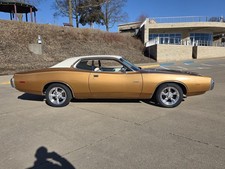
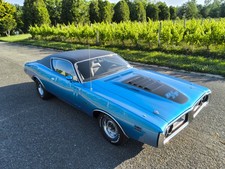
The Charger was completely restyled for 1971. Hidden headlights were now optional, not standard. A cool option was the Ramcharger hood, which allowed the driver to flip a lever under the dash, which opened a passage for clean air into the carburetor. The R/T was still available, but was discontinued for 1972. The new Rallye option replaced the R/T in 1972. 1971 was also the last year of the 426 Hemi and 440 six packs engines in the Charger, or any other Dodge model. The Charger would roll through 1974, and ten become an option on the Chrysler Cordoba from 1975 through 1978.


